It feels like magic… but it’s actually math.
You type a question.
You get a smart answer in seconds.
It almost feels like ChatGPT understands you.
But here’s the truth:
👉 It doesn’t think.
👉 It doesn’t know facts the way humans do.
👉 It predicts.
Let’s break this down in the simplest way possible.
Step 1: Your Input Becomes Data
When you type something like:
“Explain cloud computing in simple terms”
ChatGPT doesn’t see it as a “question” like a human would.
Instead, your sentence is:
👉 Broken into smaller pieces called tokens
Example:
- “Explain”
- “cloud”
- “computing”
- “simple”
- “terms”
These tokens are converted into numbers so the model can process them.
Step 2: The Model Looks for Patterns
ChatGPT is trained on massive amounts of text data.
During training, it learns patterns like:
- Words that usually come together
- Sentence structures
- Context relationships
So when you type a prompt, the model is basically asking:
👉 “What word is most likely to come next?”
Not once.
But again and again, for every word in the response.
Step 3: Prediction Happens (The Core Idea)
This is the most important concept:
👉 ChatGPT predicts the next word based on probability.
For example:
“Cloud computing is…”
Possible next words:
- “a” ✅ (most likely)
- “the”
- “an”
Then:
“Cloud computing is a…”
Next prediction:
- “technology”
- “way”
- “model”
And this continues…
👉 Word by word
👉 Sentence by sentence
👉 Until a full response is generated
Step 4: Context Makes It Smart
If ChatGPT only predicted random words, it would sound nonsense.
But here’s what makes it powerful:
👉 It uses context
That means:
- It remembers your question
- It tracks conversation flow
- It aligns responses with your intent
So instead of random text, you get:
👉 Structured
👉 Relevant
👉 Human-like answers
Step 5: The Architecture Behind It (Simplified)
At the core, ChatGPT is built using something called a Transformer model.
You don’t need to go deep into math, but here’s the idea:
- It processes words in relation to each other
- It understands which words are important
- It gives attention to key parts of your input
This is powered by something called:
👉 Attention Mechanism
Which basically means:
👉 “Focus more on what matters”
Step 6: Response Generation in Real-Time
Once everything is processed:
- Predictions are made in milliseconds
- Words are generated sequentially
- The full answer appears almost instantly
All of this happens:
👉 In real-time
👉 In the cloud
👉 At massive scale
So… Does ChatGPT Really Understand?
Short answer:
👉 No (not like humans)
What it does is:
- Recognize patterns
- Predict language
- Simulate understanding
And it does this extremely well
Why This Matters for You
If you understand this, you unlock a big advantage.
Because now you know:
👉 ChatGPT responds based on how you ask
Which means:
- Better prompts → Better answers
- Clear input → Clear output
Simple Example
Instead of:
👉 “Tell me about AI”
Try:
👉 “Explain AI in simple terms with real-world examples”
You’ll instantly see the difference.
My Personal Advice
Don’t treat ChatGPT like Google.
Treat it like:
👉 A smart assistant that needs clear instructions
The more structured your input,
the better your output.
Key Takeaway
A simple way to think about it:
👉 ChatGPT = Prediction Engine + Context Understanding
It doesn’t “know”
It predicts what sounds right
And that’s what makes it powerful.
What to Learn Next
Now that you understand how ChatGPT works, continue your journey:
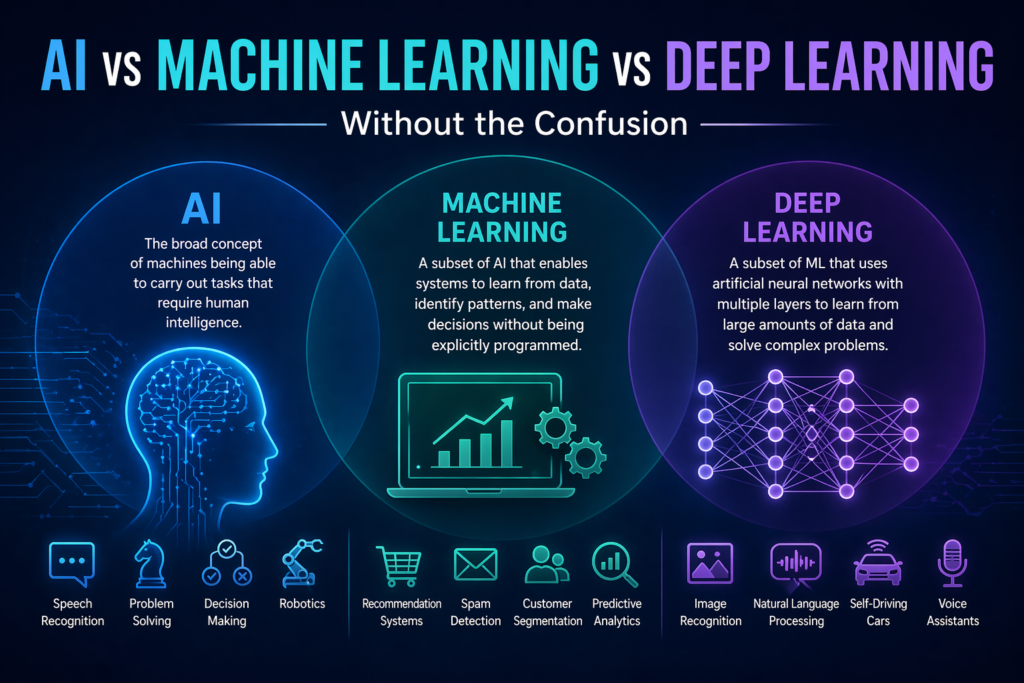
- AI vs Machine Learning vs Deep Learning
- Prompt Engineering (How to Talk to AI)
- Top AI Tools You Should Start Using
CareerFlow Academy Mission
Learn today. Apply tomorrow. Grow continuously.
You don’t need to learn everything at once.
Just understand one concept at a time.
👉 That’s how real learning happens.