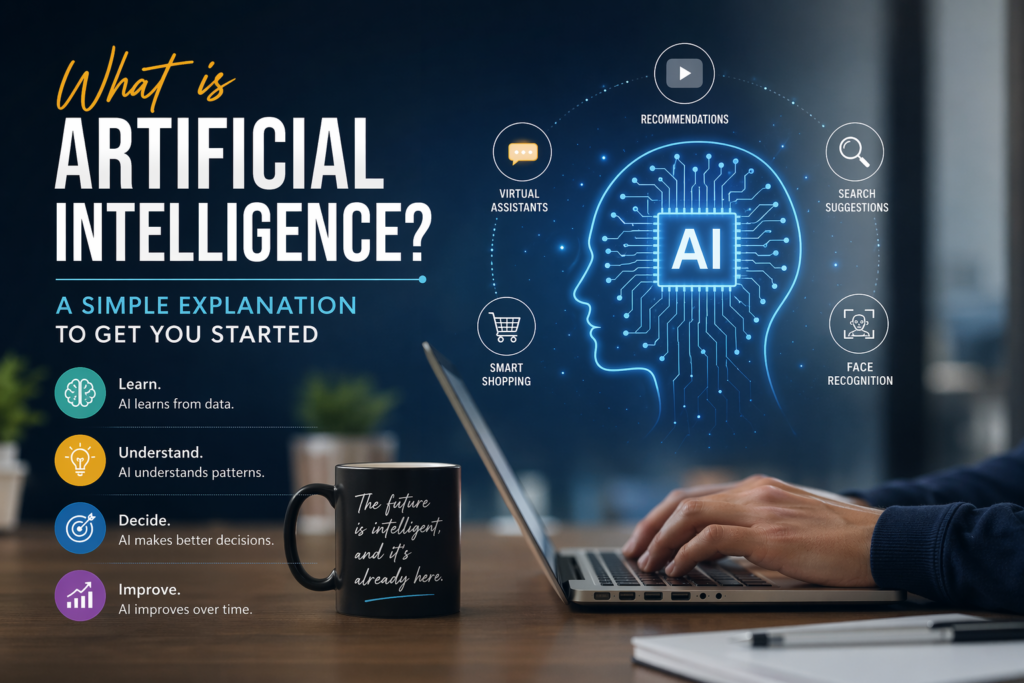
When people start exploring AI, this is usually the first point of confusion.
You hear terms like Artificial Intelligence, Machine Learning, and Deep Learning used almost interchangeably. I’ve seen this not just with beginners—even in enterprise discussions, these terms sometimes get mixed up.
I remember early in my career, I also thought they were just different names for the same thing. But once you see the relationship clearly, it becomes surprisingly simple.
Artificial Intelligence is the broader idea. It’s about machines being able to perform tasks that typically require human intelligence—like understanding language, recognizing patterns, or making decisions.
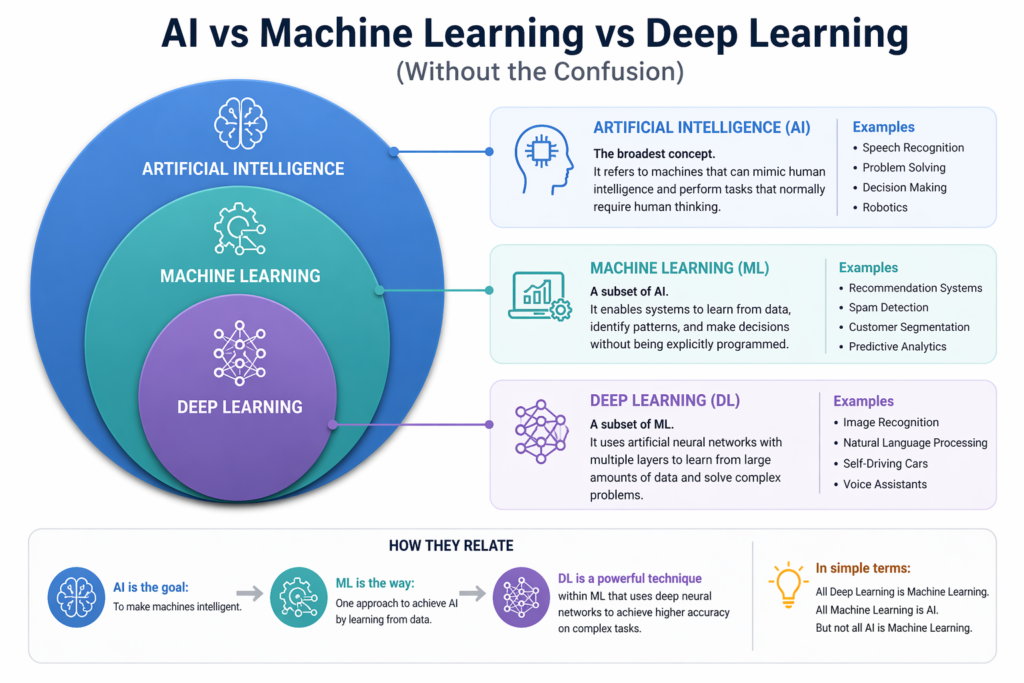
Machine Learning sits inside AI. It’s a way of achieving AI. Instead of programming every rule manually, we allow systems to learn from data and improve over time.
Then comes Deep Learning, which is a more advanced form of Machine Learning. It uses structures inspired by the human brain (called neural networks) to handle complex tasks like image recognition or voice processing.
A simple way to think about it:
AI is the goal.
Machine Learning is the approach.
Deep Learning is a specialized technique.
You don’t need to master all three today. Just understanding how they connect already puts you ahead of most people starting out.