
This is Part 15 of the Claude Series, a beginner-to-expert guide to using Claude from scratch. If you started at Part 1, this is the end of the journey. If you are jumping in here, go back to Part 1 — it is worth starting from the beginning.
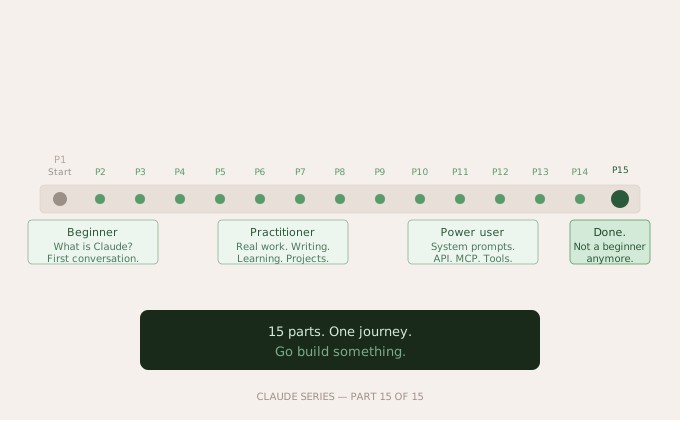
Part 1 of this series started with a simple question.
What is Claude, and why does it feel different from Google?
Fourteen posts later, you have gone from that question to building tools with the API, connecting Claude to your email and calendar, writing system prompts that shape how Claude behaves, and understanding why it gets things wrong and how to catch it.
That is not a small journey. Most people who pick up an AI tool use it for a few weeks, form an impression based on their first few sessions, and stop there. You did not do that. You stayed curious long enough to actually understand the thing.
This post is not a tutorial. There is nothing technical left to teach in this series. This is a reflection. What changed, what surprised me, and the things I wish someone had told me before I started.
The Thing That Actually Changed
When I started this series, I thought the main thing I was going to learn was prompting. How to ask Claude better questions. How to get better outputs. The craft of talking to an AI.
That did turn out to matter. But it is not the thing that actually changed how I work.
The thing that changed is this. I stopped doing first drafts alone.
Before Claude, whenever I had to write something, think through something, or figure something out, I started with a blank page and my own thoughts. Sometimes that was fine. Often it was slow, frustrating, and produced work that was less good than it needed to be.
Now I start those same tasks with a conversation. Not to outsource the thinking, but to have somewhere to put the early, messy, half-formed version of it. Claude responds. I push back. The thing clarifies. By the time I sit down to do the actual work, I already know what I think.
That is the change. Not the outputs. The process.
What Surprised Me
A few things.
I expected to use Claude most for writing. I actually use it most for thinking. The two are related but they are not the same thing. Writing is the output. Thinking is what makes the output worth reading. Claude is a better thinking partner than I expected and a slightly less impressive writer than early hype suggested.
I expected the technical parts to be the hardest. The API, MCP, the code. They were not, really. The concepts were unfamiliar but the actual doing of them was manageable once I gave myself permission to go slowly and not understand everything at once.
The hardest part was something nobody warned me about. It was learning to stay in the loop. The temptation to hand something to Claude entirely, to stop thinking because the thinking is happening in the chat window, is real and it grows over time. Every time I noticed I had drifted into passive mode, I had to consciously pull myself back. Claude is a tool that works best when you are doing the work alongside it, not watching it work.
What I Got Wrong Early On
I used it like a search engine for the first two weeks. Fast queries. Short prompts. One response, close the tab.
I used it without giving it any context. Every conversation started from scratch, with no explanation of who I was or what I was trying to do. The outputs reflected that. Generic, technically correct, not quite right for the actual situation.
I stopped at the first response too often. The first response from Claude is almost never the best one. It is a starting point. The back-and-forth is where the value is.
And I was too impressed by things that sounded good. Claude writes fluently. Fluency is not the same as correctness. It took a few embarrassing near-misses with citations and statistics before I built the habit of verifying the things that mattered.
The Habits That Stuck
After fourteen parts and several months of serious use, these are the habits that stayed.
Always give context before the work. Who I am for this task, what I am trying to achieve, what a good output looks like. Thirty seconds at the start saves five minutes of correction later.
Stay in the conversation. Do not accept the first response as final. Push back. Ask for a different approach. Tell Claude what is not working. The best outputs come from the third or fourth exchange, not the first.
Verify the specifics. Trust the reasoning. The rule from Part 10 has never failed me.
Use Projects for anything recurring. Setting up context once and having it available every session is the compounding gain that most people on the free tier are missing.
Write something myself first before asking Claude to help. Even a rough paragraph. Even a list of bullet points. The work stays mine when I start it.
Where to Go From Here
This series covered the foundations. But Claude is developing faster than any series can keep up with. By the time you read this, there will be capabilities I did not cover and use cases I did not anticipate.
So rather than giving you a list of things to learn next, I want to give you a posture.
Stay curious and stay critical. The people who use these tools well are not the ones who trust them most. They are the ones who are most honest about what the tools are and are not good for, who keep their judgment engaged, and who use the outputs as raw material rather than finished product.
Experiment with things I did not cover. Voice. Advanced Projects workflows. Building on top of the API. Connecting Claude to your own data. The foundations we built together make all of that more accessible than it would have been otherwise.
Share what you learn. The best way to deepen your own understanding is to explain something to someone else who is earlier in the journey. If this series helped you, pay that forward. Write about your experience. Help a colleague. The AI literacy gap is real and the people who understand this well have a responsibility to bring others along.
A Note on What This Series Was Really About
I want to be honest about something.
This series was never really about Claude. Claude is the subject. But the actual topic, the thing I was trying to write about across fifteen posts, is something more general.
How do you take a new tool seriously enough to actually understand it, rather than just using it on the surface and forming an impression based on your first few sessions?
That question applies to Claude. It also applies to everything else that is changing around us right now. The tools, the workflows, the ways work gets done. All of it is shifting faster than most people are comfortable with.
The people who do well in that environment are not necessarily the most technically skilled. They are the ones who stay curious, who are willing to look stupid for long enough to actually learn something, and who build understanding rather than just collecting familiarity.
You just spent fifteen posts doing exactly that.
That is worth something. More than you might think right now.
Thank You
I started writing this series because I was learning Claude myself and I could not find the resource I actually needed. The one that started from zero without being condescending, that was honest about the limitations without being discouraging, and that built up to something genuinely useful rather than just covering the surface.
I hope this was that resource for you.
If it was, I would love to hear about it. Leave a comment, reach out through the blog, or just go and do something interesting with what you have learned. That is the best feedback any writer can get.
The AI Foundation Series continues on this blog if you want to go deeper into how these systems actually work under the hood. And new content is always in progress. Subscribe below if you want to know when it lands.
Until then, go build something.
Claude Series — Part 15 of 15. Complete.