
Isn’t This Just a Fancier Google?
No. And this is the most important thing to understand before anything else.
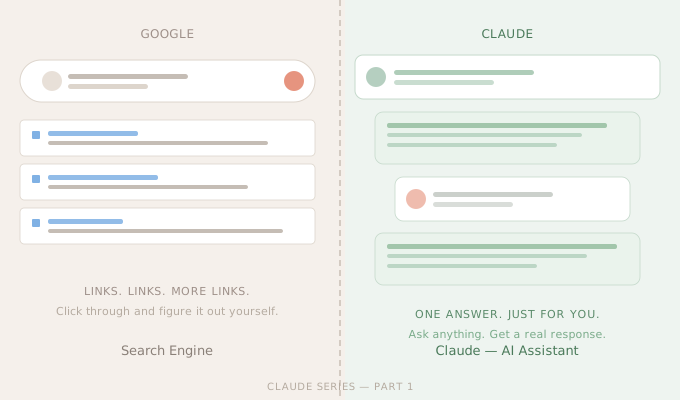
Google is a search engine. Its entire job the thing it has been doing since 1998 is to find web pages that match what you typed. When you search “best restaurants in Mumbai”, Google doesn’t know anything about restaurants. It finds pages that other people have written about restaurants, ranks them, and shows you the links. You still have to click through, read, and figure out the answer yourself.
Claude is a conversation. You don’t get a list of links. You get a response written specifically for you, in that moment, for exactly what you asked. If you tell Claude “I’m vegetarian, I’m in Bandra, I want somewhere quiet enough to have a work meeting but not so fancy it’s awkward”. it will actually engage with that whole sentence. Not match keywords. Not rank pages. Think through what you said and respond.
Here’s a way I explained it to my mother that seemed to help:
Google is like walking into a massive library and asking the librarian, “which shelf has books about this topic?” They point you to the shelf. You still have to find the right book, open it, find the right chapter, and read it yourself.
Claude is like sitting across from someone who has read the entire library and you can just ask them your question directly. They’ll give you the answer, explain why, ask if you need more detail, and adjust if you tell them they’ve missed something.
Same information. Completely different experience.
So What Is Claude, Actually?
Claude is an AI assistant built by a company called Anthropic. You can use it at claude.ai you just open it in your browser, create a free account, and start typing. That’s it. No downloads. No installation. No technical setup of any kind.
What makes Claude different from a search engine is that it was trained to understand language not just match words. It read an enormous amount of text (books, articles, conversations, code, research papers) and learned the patterns of how humans think, write, argue, explain, and communicate. So when you type something to Claude, it doesn’t look for matching keywords. It actually processes what you meant.
This is why you can be sloppy with Claude in a way you can never be with Google.
On Google, if you type “flight delay compensation what can I do UK” you get reasonable results. But if you type “my flight got cancelled this morning Heathrow to Dubai and the airline is refusing to give me anything what are my rights” Google would struggle. Too many words. Too specific. Too conversational.
Claude handles that second version easily. In fact, it prefers it. The more context you give, the better the answer you get.
The Things Claude Is Really Good At
Rather than listing abstract capabilities, let me just tell you what people actually use it for every single day.
Writing and editing. Drafting emails you’ve been putting off for three days. Rewriting a paragraph that doesn’t sound right but you can’t figure out why. Turning bullet points into a proper update for your manager. Shortening something that’s too long. Claude is genuinely excellent at this not because it produces perfect writing automatically, but because you can go back and forth with it. “Make this less formal.” “Can you make the first line more punchy?” “I don’t like the last paragraph, try again.”
Explaining complicated things simply. Tax rules. Medical reports. Legal documents. A technology your company is suddenly using. You can paste the confusing thing directly into Claude and just say “explain this to me like I’m not an expert” and it will. Actually well.
Thinking through decisions. This one surprises people. Claude is not just an information tool. You can tell it about a situation you’re dealing with a difficult conversation you need to have, a career choice you’re stuck on, a business idea you want to pressure-test and it will genuinely engage. Ask questions. Push back. Offer perspectives you hadn’t considered. It won’t make the decision for you. But it can help you think more clearly about it.
Research without the rabbit hole. You know how Googling one thing leads to seventeen open tabs and forty-five minutes later you’ve forgotten what you were originally looking for? Claude keeps the conversation in one place. You ask, it answers, you follow up, it goes deeper. No tabs. No losing the thread.
The Things Claude Is Not
This matters as much as what it can do.
Claude is not always right. This is the one that trips people up the most. Claude sounds confident. It writes in complete sentences. It doesn’t say “um” or trail off. This can make it feel more reliable than it is. But Claude can be wrong sometimes subtly, sometimes significantly. Never use Claude as your only source for anything important: medical decisions, legal situations, financial choices. Use it as a starting point. Verify the specifics.
Claude is not Google. It can’t show you live flight prices, today’s news, or your horoscope for this week. It doesn’t browse the internet in real time (unless you specifically enable that feature). Its knowledge has a cutoff date. If you need current information prices, scores, breaking news Google is still your tool.
Claude is not a person. It doesn’t have feelings. It doesn’t get tired or irritated. It doesn’t remember your previous conversations by default every time you open a new chat, you’re starting fresh. (There’s a way to work around this, which we’ll cover later in the series.) But it also doesn’t judge you. You can ask the question you were embarrassed to ask your colleague. You can say “I don’t understand, explain it differently” five times in a row and it won’t sigh at you.
Why Anthropic Built It Differently
There are several AI assistants out there now. ChatGPT is the most famous. Google has Gemini. Microsoft has Copilot. So why does Claude exist and what makes it worth using?
Anthropic the company behind Claude was founded with a specific focus on AI safety. What that means in practice is that Claude was designed from the ground up to be honest, to acknowledge uncertainty, and to avoid being helpful in ways that might cause harm. It’s less likely to confidently make things up. It’s more likely to say “I’m not certain about this” when it isn’t. It’s designed to be genuinely useful rather than just impressive-sounding.
In my experience and I’ve used most of the major AI tools at this point Claude tends to produce writing that sounds the most like a thoughtful human wrote it. Less corporate. Less formulaic. It pushes back when you’re wrong instead of just agreeing with you. And for longer, more complex tasks, it tends to hold up better.
None of that makes it perfect. But it does make it worth learning properly.
The Best Way to Think About Claude
I want to leave you with one mental model that I keep coming back to.
Think about the smartest, most well-read person you know. Someone who has a broad base of knowledge knows a little about medicine, law, finance, history, technology, writing, strategy. They’re not a specialist in everything. But they’re genuinely knowledgeable across a huge range. And crucially they’re always available, they’re never dismissive, and they have infinite patience for your questions.
That’s Claude. Not a replacement for a doctor, or a lawyer, or a specialist in whatever you need. But an incredibly useful first conversation the one that helps you understand the landscape before you go talk to the expert.
Most of us don’t have easy access to that kind of person in real life. Claude is the closest thing that’s ever existed.
What’s Next
In the next post, we’re going to get practical. We’ll open Claude together, and I’ll show you why most people talk to it the wrong way and the simple shift that makes every conversation dramatically more useful.
You don’t need to do any setup right now. But if you want to get ahead, just go to claude.ai, create a free account, and have a look around. You don’t have to type anything yet. Just get comfortable with what you’re looking at.
We’ll start talking to it properly next time. See you in Part 2
This is Blog 1 of the Claude Series a beginner-to-expert guide to using Claude, written for people who are starting from absolute zero. No jargon. No assumptions. Just honest, practical guidance.

Pingback: Claude Series — Part 11: Claude vs ChatGPT — An Honest, Unsponsored Comparison - CareerFlow Academy
Pingback: Claude Series — Part 13: Building Your First Claude-Powered Tool - CareerFlow Academy