Introduction: The Death of the “Prompt Engineer”
Start with a hook about how the job market has changed. In 2023, everyone wanted a specialist who could talk to one model. In 2026, the “AI Generalist” has emerged as the most valuable player on the team.
- The Hook: Mention that being “good at ChatGPT” is now a baseline skill, like knowing how to use email.
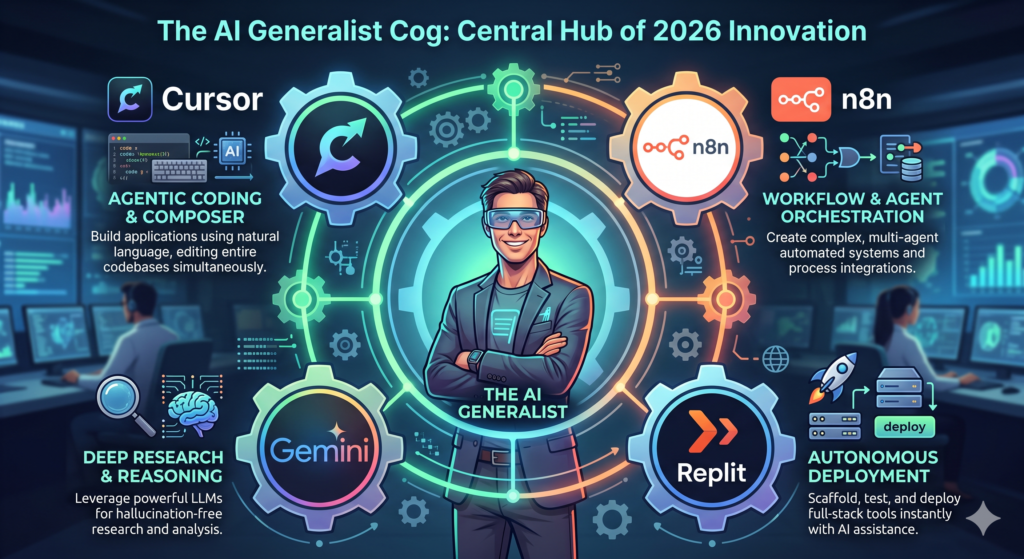
- The Definition: Define an AI Generalist as a professional who doesn’t just use one tool, but orchestrates entire systems combining automation, reasoning agents, and human oversight to solve complex problems.
Section 1: Specialist vs. Generalist (The Shift)
| Feature | AI Specialist (The Surgeon) | AI Generalist (The Architect) |
|---|---|---|
| Focus | Deep technical mastery of one model/architecture. | Connecting dots across the entire AI stack. |
| Key Skill | Fine-tuning, PyTorch, Neural Architecture. | Workflow automation, Agentic design, RAG. |
| Output | A better model. | A faster, smarter business process. |
| Value | Solving “impossible” technical problems. | Solving “expensive” operational problems. |
Section 2: The Three Pillars of the Generalist Stack
To be a successful generalist in 2026, you need to master three specific areas:
1. Agentic Workflows
It’s no longer about “one prompt, one answer.” It’s about building Agentic Workflows systems where AI agents can plan, reason, and use tools (like your CRM or Slack) to complete multi-step tasks autonomously.
2. Retrieval-Augmented Generation (RAG)
Generalists know that an AI is only as good as the data it can access. You don’t need to be a database engineer, but you must understand how to connect an LLM to a company’s private knowledge base to ensure “hallucination-free” outputs.
3. Human-in-the-Loop (HITL) Design
The smartest generalists know where AI fails. They design systems that automate 90% of the work but perfectly flag the remaining 10% for human review.
Section 3: The “Generalist Advantage” in 2026
Explain why this role is recession-proof and highly paid:
- Adaptability: When a new model (like GPT-6 or Claude 4) drops, the specialist has to relearn their niche. The generalist just swaps out a “module” in their existing workflow.
- Business Impact: Generalists speak the language of the C-suite. They don’t talk about “parameters”; they talk about “reducing customer support response time by 70%.”
- The “Team of One”: A single AI Generalist can now perform the tasks that previously required a marketing manager, a junior dev, and a data analyst.
Conclusion: How to Start Your Journey
End with a call to action or a simple roadmap:
- Stop “Prompting,” Start “Building”: Move from the chat interface to automation tools like Zapier, Make, or LangChain.
- Pick a Domain: Don’t just be an “AI guy.” Be the “AI Generalist for Supply Chain” or “AI Generalist for Legal Ops.”
- Build a Portfolio of Systems: Show off workflows, not just chat transcripts.