At CareerFlow Academy, we talk a lot about building real skills, not just learning concepts.
And if there’s one thing I’ve learned while working with customers and enterprise systems, it’s this:
AI is impressive in demos… but unreliable in real work unless you connect it to the right data.
A few months ago, I was working with a use case where a customer wanted an AI assistant to answer questions from their internal documents. Everything was already there policies, guides, knowledge base articles.
Still, people struggled to get answers.
So we tried what most people would try first: plug in a powerful AI model.
The result?
Fast answers. Fluent answers.
But not always correct answers.
That’s when it became clear the issue wasn’t AI capability.
The issue was that AI didn’t have access to the right information at the right time.
That’s where RAG changed everything.
What RAG really means (in simple terms)
RAG stands for Retrieval-Augmented Generation, but don’t let the name intimidate you.
At CareerFlow, we simplify things:
RAG = AI that checks your data before answering
Instead of guessing, it searches.
Instead of assuming, it verifies.
Think of it like this:
- A normal AI = someone answering from memory
- A RAG system = someone who quickly checks notes and then answers
Which one would you trust in a real job?
Why this skill matters for your career
If you’re learning AI today, it’s easy to get distracted by:
- Complex models
- Deep learning theory
- Fancy tools
But here’s the reality from industry experience:
Companies don’t need “more AI.”
They need AI that works with their data.
That’s exactly what RAG enables.
This is why RAG is not just a concept—it’s a career skill.
It helps you move from:
- Learning AI → Applying AI
- Building demos → Solving problems
How RAG works (without overcomplicating it)
Let’s break it down in a way that actually makes sense.
When you build a RAG system, three things happen:
- Your data is prepared
Documents, PDFs, or internal content are processed so AI can understand them better - The system learns how to find meaning
It doesn’t just search keywords it understands context - Answers are generated using real data
When a question is asked, it fetches relevant information first, then responds
The important shift here is simple:
AI stops guessing… and starts responding with context.
Where RAG is used in real life
This is where things get interesting. These are not future ideas these are happening right now.
- Customer support systems
AI answers queries using real company knowledge - Internal company assistants
Employees get instant answers without digging through documents - Learning platforms (like what you can build)
Imagine students asking questions and getting answers from course material - Developer tools
Helping teams understand internal codebases faster
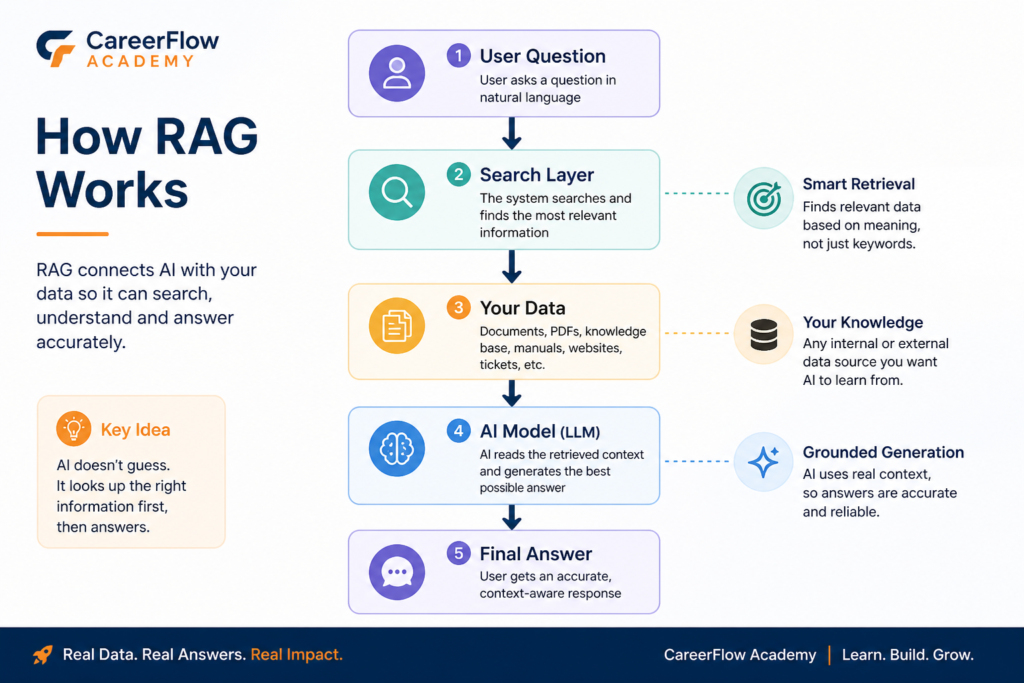
A simple visual to understand RAG
You can convert this into a clean diagram image for your blog:
        User Question
              ↓
     ┌─────────────────┐
     │   Search Layer  │  ← Finds relevant data
     └─────────────────┘
              ↓
     ┌─────────────────┐
     │  Your Data      │  (Docs, PDFs, KB)
     └─────────────────┘
              ↓
     ┌─────────────────┐
     │   AI Model      │  ← Uses retrieved data
     └─────────────────┘
              ↓
        Final Answer
 (Accurate + Context-Aware)
Simple way to explain this:
- The system searches first
- Then AI thinks
- Then it answers
That order makes all the difference.
Common mistake beginners make
I see this pattern often.
Beginners tend to:
- Focus too much on learning models
- Delay building real projects
- Assume AI alone will solve problems
But here’s the truth:
The best AI practitioners are not the ones who know the most…
They are the ones who can solve real problems with simple approaches.
RAG is one of those approaches.
How you can start today
You don’t need a big system. You just need a starting point.
- Take a simple document (PDF or notes)
- Build a small app where you can ask questions
- Use any AI API + basic retrieval logic
That’s your first RAG project.
And trust me that one project teaches more than hours of theory.
Final thought (CareerFlow mindset)
At CareerFlow Academy, I believe in one thing:
Skills should make you useful—not just knowledgeable.
RAG is one of those rare skills that:
- Is easy to start
- Has real-world demand
- Creates immediate impact
So if you’re serious about becoming an AI practitioner, don’t just learn how AI thinks.
Learn how to make AI useful.
That’s where your real growth begins.

Pingback: Advanced RAG: How Real AI Systems Are Actually Built - CareerFlow Academy