
This is Part 7 of the Claude Series, a beginner-to-expert guide to using Claude from scratch. If you’re just joining, start with Part 1: What Is Claude and Why Does It Feel Different From Google?
Most articles about using Claude at work talk about writing emails and summarising documents.
Those are fine. We covered them in Part 4. But they are the surface layer. The use cases that get mentioned first because they are the easiest to explain, not because they are the most valuable.
After a few months of using Claude seriously in a professional context, the things that have actually made a difference to how I work are almost none of the things that get written about. They are quieter. Less glamorous. And consistently more useful.
This post is about those.
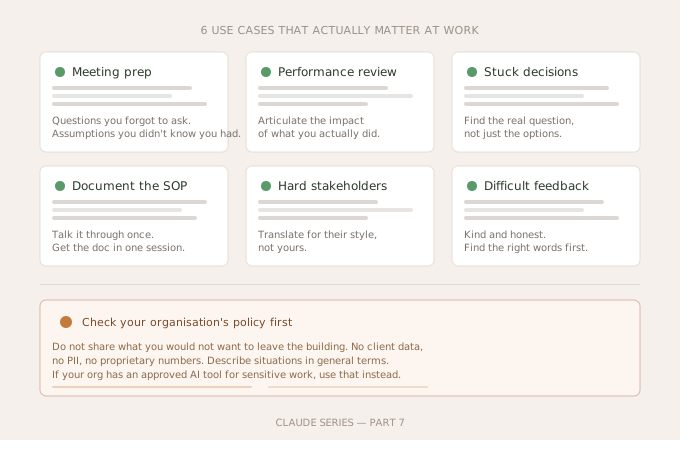
Before the Meeting You Are Not Ready For
Most people walk into meetings underprepared. Not because they are lazy but because preparation takes time they do not have, and a vague scan of the agenda feels like enough until you are sitting in the room and realise it is not.
Here is what I do now before any meeting that matters.
I open Claude and tell it who I am meeting, what the meeting is about, what I want to get out of it, and what I am uncertain about going in. Then I ask it two things. First, what are the questions I should be asking that I probably have not thought of? Second, what should I know about this topic or this kind of conversation that I might be assuming wrongly?
That second question is the one that consistently surprises me. There is almost always something I was assuming that I should not have been. A dynamic I had not considered. A piece of context that would change how I approach the conversation.
I also ask Claude to play the other person in the meeting and push back on whatever I am planning to say. This is uncomfortable. It is supposed to be. Walking into a difficult conversation having already heard the strongest version of the counter-argument is a different experience from walking in cold.
Ten minutes of this before a meeting changes the quality of what happens in it.
The Performance Review You Keep Putting Off
Writing a self-assessment is one of those tasks that feels simple until you sit down to do it and find that the combination of self-promotion and honest reflection required is genuinely hard to get right.
Most people write self-assessments that are either too modest or too vague. They undersell things that actually mattered or they describe outcomes without connecting them to the work that produced them.
I give Claude a rough list of things I did over the review period. Not polished. Just the actual list. Then I ask it to help me articulate the impact of each one in a way that is specific and honest without sounding like a press release. I tell it the audience, which is usually a manager or an HR process, and the tone I want, which is usually direct and grounded rather than enthusiastic.
The result is not something I paste directly. It is a draft that shows me how the things I did can be described in a way that actually communicates their value. Then I rewrite it in my own words, which takes a fraction of the time it would have taken from scratch.
The Decision You Cannot Get Out of Your Head
There is a particular kind of professional decision that is not about analysis. You have the data. You know the options. The problem is that you keep going around in circles because something about the framing is off and you cannot see what it is.
These are the decisions I find Claude most unexpectedly useful for.
I describe the situation in full. The options, the constraints, the things I know, the things I am uncertain about, and crucially, what it feels like I am actually deciding between at the deepest level. Then I ask Claude not to give me a recommendation but to help me find the question I am actually trying to answer.
That framing, finding the real question, is often where the loop breaks. The decision feels impossible because you are solving the wrong problem. Claude is remarkably good at pointing to where the real tension is, usually something about values or identity or risk tolerance rather than the surface-level options you are weighing.
It does not make the decision for you. Nothing should. But it gets you unstuck in a way that another Google search usually does not.
The SOP That Has Been in Your Head for Two Years
Most professionals have processes they do repeatedly that exist entirely in their heads. Things they could hand off to someone else in theory but have never documented because documenting them properly would take more time than just doing the thing again.
Claude makes this faster than you would believe.
Talk Claude through the process out loud, the way you would explain it to a new colleague over a coffee. Stream of consciousness. Every step you actually do, including the ones you do automatically without thinking. Ask it to stop you when something is unclear and ask a clarifying question.
At the end, ask Claude to turn what you just described into a clean step-by-step document. Tell it the format you want. Tell it the audience. Tell it what level of detail is right.
What comes out will not be perfect. But it will be 80% of the way there from a single conversation, rather than the document you have been meaning to write for two years that still does not exist.
The Stakeholder Who Is Hard to Communicate With
Every professional has at least one. The person whose communication style is very different from yours. The executive who wants three bullets and you naturally write three pages. The technical colleague who loses interest the moment you go abstract. The client who needs everything in terms of business outcomes and goes blank when you mention process.
Before communicating with that person on something important, describe them to Claude. Not their name, just their communication style, their priorities, what they care about, what makes them switch off. Then share what you are trying to communicate and ask Claude to translate it for that specific reader.
This is not about being manipulative. It is about being understood. The same information lands completely differently depending on how it is framed. Claude is very good at reframing without changing the substance.
The Feedback You Do Not Know How to Give
Giving honest feedback that is also kind is one of the hardest professional skills there is. Most people either soften it so much it loses meaning or deliver it so directly it damages the relationship. Finding the line between those two things in the moment, when you are also managing your own discomfort, is genuinely hard.
Describe the situation to Claude. What happened, what the impact was, what you want the other person to understand, and what outcome you are hoping for from the conversation. Ask Claude to help you find the words.
Then, as with Part 5 on writing, do not paste what it gives you. Read it. Take the parts that feel true and rewrite them in your own voice. Use it as a mirror that shows you what you are trying to say before you say it.
Before Any of This: Check Your Organisation’s Policy
This is something I should have said at the top, and I want to say it clearly before you take any of the above into your workplace.
Every organisation is different. Some actively encourage the use of AI tools. Some are still figuring out their position. Some have specific rules about what can and cannot be shared with external tools. A few have outright restrictions.
Before you use Claude for any work-related task, find out where your organisation stands. This is not a legal disclaimer. It is practical advice. If your company has an AI usage policy, read it. If you are not sure whether one exists, ask your IT or compliance team. If you are in a regulated industry like banking, healthcare, or law, the stakes around data handling are higher and the policies tend to be more specific.
The use cases in this post are designed with a simple principle in mind: do not share what you would not want to leave the building. Claude is not the right place for client-confidential data, personally identifiable information, proprietary financial details, or anything your organisation would consider sensitive. The meeting prep, the self-assessment, the decision framing, the feedback drafting — all of these can be done by describing the situation in general terms without naming people, sharing documents, or pasting in data you do not have permission to use externally.
If your organisation has approved specific enterprise tools or internal AI deployments, those are the right channel for anything sensitive. Claude on the public platform is best used for your own thinking, your own writing, and your own professional development. That is where it adds the most value anyway.
The goal here is to help you work better within the rules you operate in, not around them.
The Pattern Across All of These
Looking back at the six things above, there is something they all have in common.
They are not tasks where the hard part is the information. You already have most of the information. The hard part is the thinking. The framing. The translation. The clarity about what you actually mean and what you actually want.
Claude is not an information tool when it is working at its best. It is a thinking partner. The question is whether you are using it that way.
Most people are not yet. The people who are tend to find that it changes not just specific tasks but how they approach their work more broadly. Because once you have a space to think out loud without consequence, you start thinking differently.
What’s Next
Part 8 is where the series takes a step up.
We have spent seven parts on how to have good conversations with Claude. Part 8 is about something different: how to give Claude a persistent set of instructions so that every conversation in a given context starts exactly where you need it to. No re-explaining yourself. No re-establishing tone. Claude already knows.
It is called a system prompt, and once you have written one, you will not want to go back.
Claude Series — Part 7 of 15. A beginner-to-expert guide to using Claude, written for people starting from absolute zero. No jargon. No assumptions.