
When we talk about Artificial Intelligence, we usually jump straight to talking about “thinking machines” or digital brains. But this week, as I sat down for my first 8-hour block of AI study, I realized the truth is much weirder and much more logical.
To an AI, my morning tea and a $500,000 house in California are essentially the same thing. They are just Vectors.
The “Aha!” Moment: The Vector
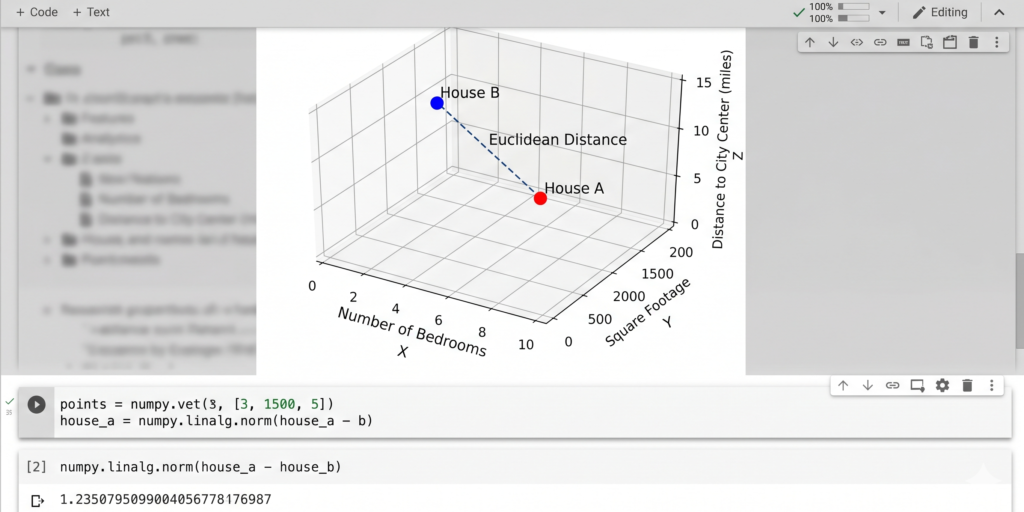
Before an AI can “reason,” it has to “measure.” I learned that AI doesn’t “see” a house. It sees a list of features. In my first lab session using Google Colab, I represented two houses as simple lists of numbers, which programmers call Arrays.
- House A: 3 bedrooms, 1500 sq. ft, 5 miles from downtown →
[3, 1500, 5] - House B: 2 bedrooms, 800 sq. ft, 12 miles from downtown →
[2, 800, 12]
In Python, it looks like this:

Calculating “Vibes” with Math
The most fascinating part of this first session was learning how AI determines if two things are “similar.” It doesn’t “feel” the vibe of the house; it calculates the Euclidean Distance.
Think back to high school geometry (the Pythagorean theorem). If you plot these houses on a graph, the distance between the two dots tells the AI how similar they are. If the distance is small, the houses are similar. If it’s huge, they are worlds apart.
I ran a quick calculation in my notebook:

The result? A “Difference Score” of 700.04.
The Takeaway
This was my first real lesson: AI is just high-speed geometry. Whether it’s Netflix recommending a movie or a self-driving car identifying a pedestrian, the underlying process is the same:
- Turn the world into a list of numbers (Vectors).
- Plot those numbers in a massive, invisible space.
- Calculate the distance between them.
My “Breaking” Experiment
To see how fragile this logic is, I tried a “stress test.” I created a third house with 5,000 bedrooms. Suddenly, the “distance” exploded. This taught me a vital lesson for next week: Data Cleaning. If I feed an AI “garbage” numbers, the geometry breaks, and the “brain” fails.
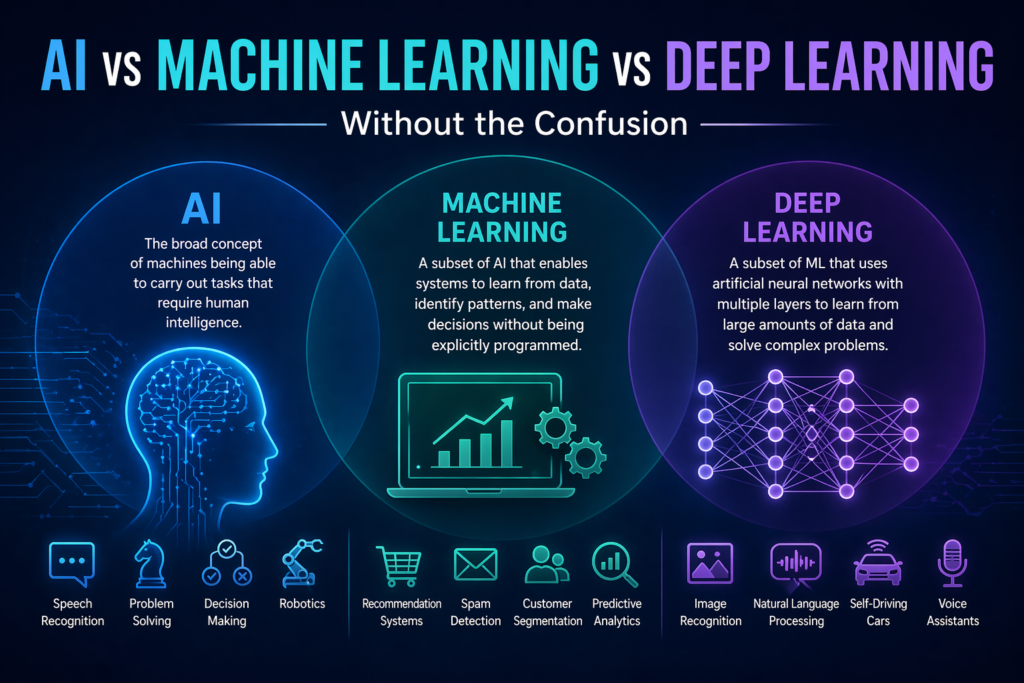
Next Week: I’ll be moving from comparing two houses to analyzing a dataset of 20,000 California homes. We’re going from simple math to actual Machine Learning.

Github Repo: https://github.com/ankitsrivastava/ai-foundation-series/blob/main/AI_foundation_Series.ipynb?short_path=5388780

Pingback: AI Foundation Series: The Ghost in the Data: My First 17,000 Houses - CareerFlow Academy