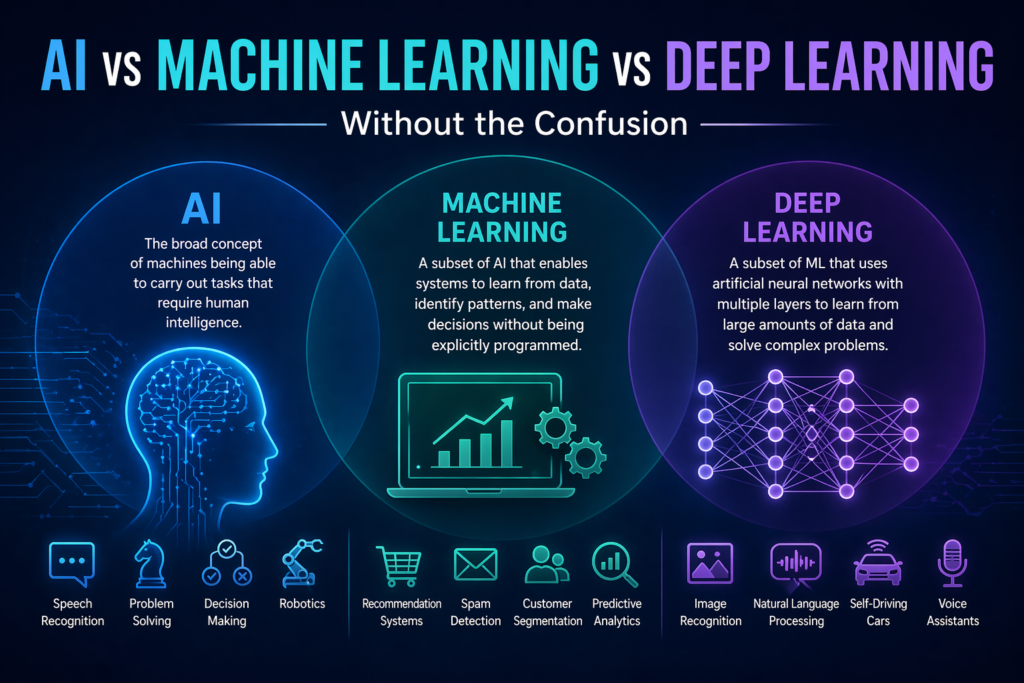
When I first started exploring AI seriously, it felt almost magical.
You type something into ChatGPT and within seconds, you get a well-written answer. Clean. Structured. Sometimes even better than what you would write yourself on a good day.
Naturally, like most people, I thought:
“This is it. This is the peak of AI.”
But the deeper I went, the more I realised…
This is just the beginning.
Because what we are mostly using today is Generative AI.
And what’s coming next is something far more powerful Agentic AI.
The Illusion of Intelligence
Let’s start with something honest.
Generative AI feels intelligent because it responds beautifully.
It can:
- Write blogs
- Generate code
- Explain complex topics
- Even simulate human-like conversations
Underneath, it is powered by things like Large Language Models systems trained to predict what comes next based on patterns.
A simple way I think about it is this:
It doesn’t know… it predicts extremely well
And that prediction is so good, it feels like understanding.
But there’s a limitation most people don’t notice immediately.
It only moves when you ask.
Where Generative AI Falls Short
After months of using it, I started noticing a pattern.
Every interaction looked like this:
- I ask
- It responds
- I refine
- It improves
It’s powerful, yes.
But it’s also… dependent.
It doesn’t take initiative.
It doesn’t plan ahead.
It doesn’t execute anything beyond the response.
That’s when the next shift starts to make sense.
Enter Agentic AI — The System That Acts
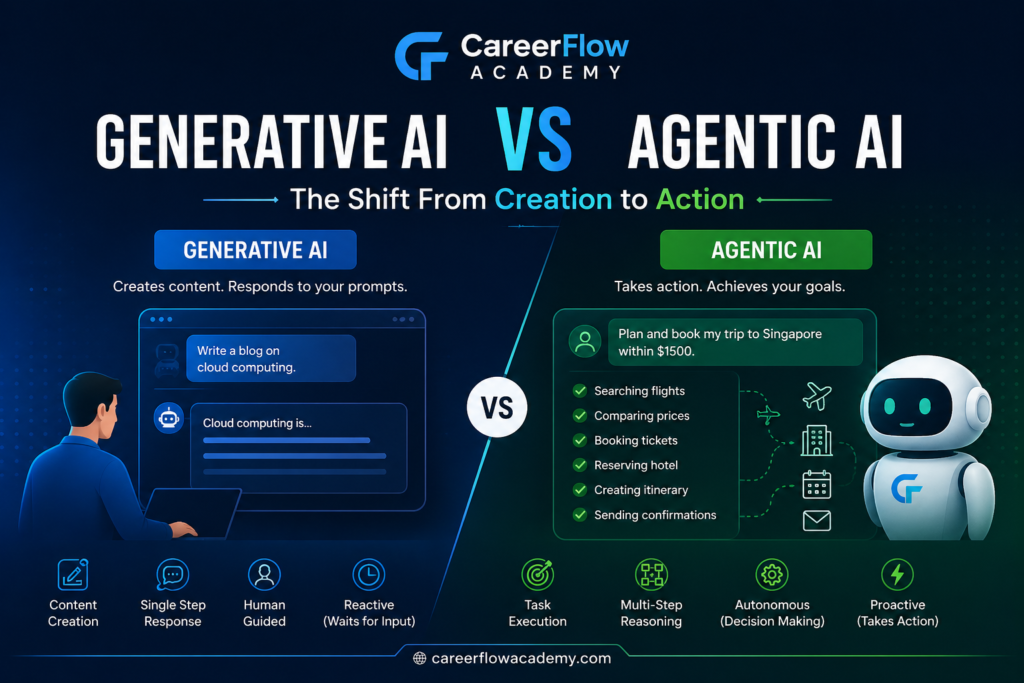
Agentic AI is not just about generating answers.
It’s about getting things done.
And this is where the mental model needs to change.
Instead of saying:
“Give me the answer”
You start saying:
“Achieve this outcome”
And the system figures out the steps.
A Simple Way to See the Difference
Let me explain this the way I usually explain to my learners.
Imagine you’re planning something as simple as a trip.
With Generative AI:
You ask for a plan… and you get a great itinerary.
But after that?
You are still the one:
- Booking flights
- Comparing prices
- Managing timelines
Now imagine Agentic AI in the same situation.
You define the goal once.
And the system:
- Searches options
- Makes decisions
- Executes bookings
- Adjusts if something fails
At that point, AI is no longer just “helping”.
It’s operating.
What Actually Changed?
This is not a completely new invention.
Agentic AI is built on top of the same foundation as tools like Claude or Google Gemini.
But a few critical layers are added:
- Memory
- Planning
- Tool usage
- Decision-making logic
Concepts like Reinforcement Learning start playing a bigger role here.
And suddenly, AI is no longer a “single response system”.
It becomes a multi-step thinking system.
Why This Shift Matters (More Than You Think)
From a career perspective, this is a big moment.
Because the skill is no longer just:
“How well can you prompt AI?”
The real skill becomes:
“Can you design systems that use AI to solve problems?”
That’s a completely different level.
It connects deeply with:
- APIs
- Cloud platforms
- Workflow orchestration
- System thinking
And if you already come from a background like cloud or enterprise systems… this is your advantage.
My Realisation While Building CareerFlow Academy
While building content and thinking about how to teach AI in a practical way, one thing became very clear to me:
People don’t just need AI tools.
They need a new way of thinking.
Because very soon:
- Everyone will have access to Generative AI
- But very few will know how to build Agentic systems
And that gap?
That’s where the real opportunity is.
So Where Should You Focus?
If you’re early in your journey, don’t rush.
Start simple.
Understand how Generative AI works.
Learn how to communicate with it effectively.
But don’t stop there.
Slowly start asking:
- How can this connect to other systems?
- How can this automate something real?
- How can this run without me constantly guiding it?
That’s where the shift begins.
Final Thought
We are moving through three phases:
First, AI that responds
Then, AI that assists
And now… AI that acts
And honestly, this is the phase where things start getting interesting.
Because now the question is no longer:
“What can AI generate?”
It becomes:
“What can AI take off your plate completely?”