
This is Part 10 of the Claude Series, a beginner-to-expert guide to using Claude from scratch. If you’re just joining, start with Part 1: What Is Claude and Why Does It Feel Different From Google?
This is the post I have been building towards since Part 1.
Every other part in this series has been about getting more out of Claude. Better prompts. Better conversations. Better use of Projects and system prompts. All of that is genuine and useful.
But none of it matters if you do not understand this: Claude can be wrong. Confidently, fluently, convincingly wrong. And if you do not know how to spot it, you will eventually publish something incorrect, make a decision based on bad information, or share something with a colleague that quietly embarrasses you.
This is not a reason to stop using Claude. It is a reason to use it with the same critical eye you would bring to any source of information. Maybe more so, because Claude sounds more confident than most sources.
What Hallucination Actually Means
The word hallucination gets used a lot in AI coverage and it often sounds more dramatic than it is. Let me explain what it actually means in plain terms.
Claude generates language by predicting what words should come next, based on patterns learned from enormous amounts of text. Most of the time this works brilliantly. But occasionally, especially when asked about specific facts, names, dates, statistics, citations, or niche topics, the pattern-matching produces something that sounds right but is not.
A hallucination is not Claude lying. Claude has no intent to deceive. It is Claude generating a plausible-sounding answer in a situation where it does not actually know the correct one. The problem is that it does not always signal the difference between the two.
This is the specific failure mode to understand. Claude does not always know what it does not know. It can produce an invented book title in the same confident tone it uses to describe a real one. It can cite a study that does not exist with the same fluency it uses to explain a concept it genuinely understands.
The Situations Where It Happens Most
Not all Claude outputs carry the same risk. Some things Claude gets right almost all the time. Others are significantly more prone to error.
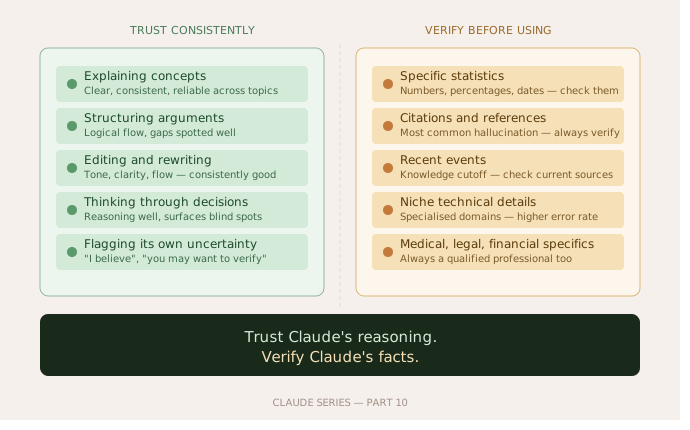
Specific facts with precise details
Dates, statistics, percentages, prices, measurements. Any time the correct answer requires a specific number or date, treat Claude’s output as a starting point rather than a final answer. It may be right. It may be close but not quite right. It may be wrong in a way that is hard to spot without checking.
Named sources, citations, and references
This is where hallucination is most common and most problematic. If you ask Claude to cite studies, quote experts, or reference specific articles, verify every single one before you use it. Claude will sometimes produce a citation that looks entirely plausible, with a real author’s name, a real journal, and a realistic title, that does not actually exist. This is not occasional. It is a known and consistent failure mode.
Recent events and current information
Claude’s knowledge has a cutoff date. Anything that happened after that cutoff, Claude does not reliably know. But it does not always say so. It will sometimes produce an answer about recent events that sounds authoritative but is based on outdated information or extrapolation. If recency matters, check a current source.
Niche or specialised topics
The more specific and specialised the topic, the higher the risk of error. Claude is excellent across a broad range of general knowledge. The further you go into highly specific professional domains, the more carefully you need to read what it produces.
The Habits That Protect You
None of this requires paranoia. It requires a few simple habits applied consistently.
Verify anything specific before you use it
If Claude gives you a statistic, look it up. If it names a study, check that the study exists. If it gives you a date, confirm it. This takes seconds for most things and it is the single most important habit you can build. The goal is not to verify everything Claude says. It is to verify anything you are about to act on or share with someone else.
Notice when Claude is uncertain
Claude is actually quite good at signalling uncertainty when it is uncertain. It uses phrases like “I believe”, “I think”, “I am not certain”, “you may want to verify this”. These are genuine signals, not filler. When you see them, take them seriously. The absence of those signals does not mean Claude is certain. But their presence definitely means it is not.
Ask Claude to flag its uncertainty
You can build this directly into your prompts. Add a line at the end: “If you are not confident about any specific fact in this response, please flag it clearly.” Claude responds well to this instruction and it makes the uncertain parts visible rather than invisible.
Use Claude for reasoning, not just for facts
The areas where Claude is most reliable are also the areas where it is most useful. Explaining concepts. Helping you think through a problem. Structuring an argument. Editing writing. Generating options. None of these require Claude to have precise factual knowledge. They require it to reason well, which it does consistently.
The areas where Claude is least reliable, specific facts and citations, are also the areas where it is easiest to verify. A quick search confirms or corrects a statistic in thirty seconds.
Do not use Claude as your only source for anything important
Medical decisions. Legal situations. Financial choices. Anything where being wrong has real consequences. Claude is an excellent starting point for understanding a topic in these areas. It is not a substitute for a qualified professional or for verified primary sources.
A Story That Illustrates This
Early in my time using Claude I was writing something that referenced a piece of research. I asked Claude to help me find supporting evidence for a point I was making. It produced a study. Author, journal, year, finding. It looked entirely legitimate.
I almost used it without checking. Something made me pause and search for the paper. It did not exist. The journal was real. The author was a real researcher in the field. But the specific paper Claude described had never been published.
I went back to Claude and told it the paper did not exist. It apologised and acknowledged that it had generated a plausible-sounding citation rather than a real one. It was not defensive about it. It explained that this was a known limitation.
That experience changed how I use Claude for anything research-related. Not by making me distrust it broadly, but by making me verify citations specifically, every single time, without exception.
What Claude Does Well in This Regard
It is worth saying clearly that Claude is significantly better than many AI tools at acknowledging its own limitations.
If you ask Claude directly whether it is certain about something, it will usually tell you honestly. If you ask it to distinguish between what it knows confidently and what it is less sure of, it will often do that well. If you push back on something it said and provide a correction, it will generally engage with that correction genuinely rather than defending a wrong answer.
These are not small things. They make Claude a more trustworthy tool than one that projects uniform confidence regardless of the underlying certainty.
The lesson is not to distrust Claude. It is to use it actively rather than passively. To ask it to flag uncertainty. To verify the things that matter. To treat it as a very knowledgeable colleague whose work you would still review before forwarding to a client, not because you doubt their ability but because that is simply good practice.
The Simple Rule
Here is the rule I use, and it has never let me down.
Trust Claude’s reasoning. Verify Claude’s facts.
Reasoning is what it does best. It thinks clearly, structures well, explains elegantly, and spots things you missed. That is consistent and reliable.
Facts, especially specific ones, need a second source. Not because Claude is usually wrong. Because when it is wrong, it does not always know it.
What’s Next
Part 11 is the comparison post the internet does badly.
Claude versus ChatGPT. Everyone has an opinion. Most of those opinions are based on one or two tasks that happened to go a particular way on a particular day. Part 11 is an honest, unsponsored, side-by-side look at where each one actually wins, where it loses, and what that means for how you should think about using them.
No drama. Just the genuine differences that matter in practice.
Claude Series — Part 10 of 15. A beginner-to-expert guide to using Claude, written for people starting from absolute zero. No jargon. No assumptions.