
This is Part 6 of the Claude Series, a beginner-to-expert guide to using Claude from scratch. If you’re just joining, start with Part 1: What Is Claude and Why Does It Feel Different From Google?
There is a difference between knowing something and understanding it.
Knowing is when you can repeat the answer. Understanding is when you can use it, question it, connect it to something else, explain it to someone who has never heard of it.
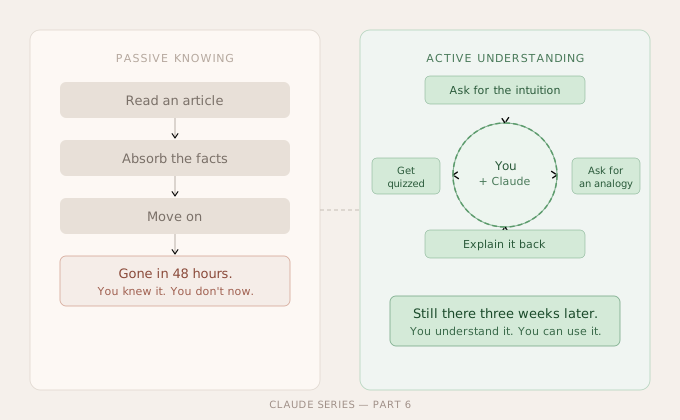
Most of the ways we consume information give us knowing. We read an article, we absorb the facts, we move on. But if someone asks us about it three weeks later, we have the vague shape of it without the substance.
I have been using Claude in a way that consistently gets me to understanding rather than just knowing. It takes a bit more effort than reading an article. But the things I have learned this way have actually stayed with me, which is more than I can say for most of what I read.
This is how it works.
The Problem With Reading for Information
Here is something worth sitting with for a moment.
Think about the last ten articles you read. How many of them could you explain clearly to someone else right now? Not the headline, not the general vibe, but the actual argument, the key insight, the thing that made it worth reading?
For most people the answer is one or two, maybe three if it was a really good week.
This is not a memory problem. It is a processing problem. Reading is passive. Your eyes move across the words, something registers, and then you move on. Unless you do something with what you read, most of it evaporates within 48 hours.
This is why using Claude as a search engine is such a waste. You ask a question, you get an answer, you close the tab. The information came in and went straight back out again.
The better approach is to use Claude the way a good teacher uses questioning. Not to get answers but to build understanding.
The Method I Actually Use
It starts with a topic I genuinely want to understand. Not just know about. Understand.
I open Claude and instead of asking “what is X?” I say something like: “I want to properly understand X. I have a basic sense of what it is but I want to actually get it. Can you start by explaining the core idea in plain language, and then we will go from there?”
That framing does two things. It tells Claude I want depth, not a summary. And it signals that this is going to be a conversation, not a one-shot answer.
From there I follow the thread. When something Claude says is not clear, I say so. “I did not follow that last part. Can you try a different way?” When something is interesting, I go deeper. “You mentioned X in passing. Can we spend more time there?” When I think I understand something, I test it. “Let me see if I have got this right. My understanding is that… is that correct?”
That last one is the most important. Trying to explain something back in your own words is how you find out whether you actually understood it or just followed along. Claude will gently correct you when you get it wrong and confirm when you get it right.
The whole thing feels less like reading and more like a tutorial with someone who has unlimited patience and no agenda.
The Five Moves That Make It Work
These are not rules. They are just the things I reach for most often when I am trying to genuinely learn something.
Ask for the intuition before the detail
Most explanations go straight to how something works without first explaining why it matters or what problem it solves. Ask Claude: “Before we get into the mechanics, can you give me the intuition? Why does this thing exist? What problem does it solve?” Once you have that, the details have somewhere to land.
Ask for an analogy
Abstract concepts become concrete when you map them to something familiar. Ask Claude: “Can you explain this using an analogy from everyday life?” And if the first analogy does not click, ask for another one. Different analogies work for different people. There is no shame in asking for three.
Ask where people usually get confused
This is a question most people never think to ask. “What is the part of this topic that most people find confusing or get wrong?” Claude will often point you straight to the conceptual trap that is worth avoiding. Knowing where the confusion usually lives helps you watch for it in yourself.
Ask it to quiz you
Once you think you have understood something, ask Claude to test you. “Ask me five questions about what we just covered.” Trying to answer questions is completely different from feeling like you understood the explanation. The gaps become very obvious very quickly. But the gaps are also exactly where the real learning happens.
Ask how it connects to things you already know
Isolated knowledge is fragile. Knowledge that connects to other things you already understand is sticky. Ask Claude: “How does this connect to what I already know about Y?” or “Where does this fit into the bigger picture of Z?” Making connections between ideas is what turns information into understanding.
A Real Example
Last month I wanted to understand how interest rates affect inflation. I had read about it a dozen times and still could not clearly explain the mechanism. So I tried this approach.
I told Claude I wanted to actually understand it, not just know the headline. We started with the intuition. Why do central banks raise rates when inflation is high? What are they actually trying to do? Claude explained it in plain terms. I asked for an analogy. It gave me one using a city with too many people chasing too few apartments. That clicked.
Then I asked where people usually get confused. Claude pointed out that most people think rate rises reduce inflation directly, when actually the mechanism is indirect and works through behaviour change. That was exactly the gap in my understanding.
I tried to explain the mechanism back in my own words. I got parts of it right and parts wrong. Claude corrected the wrong parts without making me feel stupid about it. I asked it to quiz me. I got three out of five questions right.
By the end of that conversation I could explain the relationship between interest rates and inflation to someone else clearly enough that they would actually understand it. I could not have done that after reading ten articles on the topic.
That is the difference.
The One Thing to Avoid
The temptation, once Claude has explained something well, is to screenshot it or copy it and feel like the learning is done.
It is not.
What Claude produced is a good explanation. Reading a good explanation is still passive. The learning only happens when you engage with it. When you push back, ask follow-up questions, try to explain it back, or connect it to something else.
Do not collect explanations. Have conversations.
What This Changes About Learning
Once you start using Claude this way, a few things shift.
You stop avoiding topics that feel intimidating. Quantum computing, macroeconomics, contract law, whatever the thing was that always seemed too complex to get into. Claude meets you exactly where you are and builds from there. The starting point does not matter.
You stop pretending to understand things you do not. Because you can always just ask. The pressure to look like you already know something disappears when you have a private space to figure it out from scratch.
And you start to notice when you actually understand something versus when you just recognise it. That distinction, once you can feel it clearly, changes how you approach reading and learning entirely.
Try This Today
Pick one topic you have been vaguely meaning to understand properly for a while. It does not have to be big. It could be something from your industry, something you read about recently, something a colleague mentioned that you nodded along to without fully following.
Open Claude and say: “I want to actually understand X, not just know about it. Can you start with the core intuition and we will build from there?”
Then stay in the conversation. Ask follow-up questions. Push back when something is not clear. Try to explain it back before the end.
See how different it feels from reading an article.
What’s Next
Part 7 is going to be for people who are already in a job and want to use Claude to work better.
Not writing tips. Not generic productivity advice. Specific use cases that working professionals actually find valuable but almost nobody writes about. The meeting prep, the performance review, the decision framework, the SOP you have been meaning to document for two years.
The practical stuff that makes a real difference week to week.
See you in Part 7.
Claude Series — Part 6 of 15. A beginner-to-expert guide to using Claude, written for people starting from absolute zero. No jargon. No assumptions.