
This is Part 5 of the Claude Series, a beginner-to-expert guide to using Claude from scratch. If you’re just joining, start with Part 1: What Is Claude and Why Does It Feel Different From Google?
Let me tell you about a mistake I see constantly.
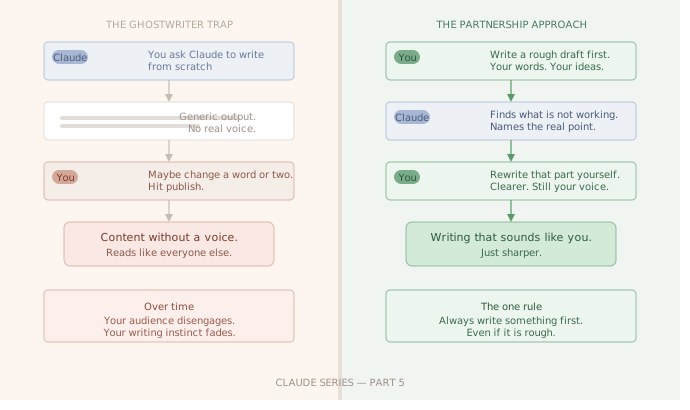
Someone discovers Claude. They realise it can write things. So they start asking it to write everything. Blog posts, emails, LinkedIn updates, reports, proposals. They paste what comes out, maybe change a word or two, and hit publish.
And then they wonder why nobody engages with their content anymore. Why their emails feel slightly off. Why their writing has started to sound like everyone else’s writing, which has started to sound like nobody in particular.
The problem is not Claude. The problem is how they are using it.
There is a version of using Claude for writing that replaces your voice. And there is a version that sharpens it. Most people accidentally end up in the first one. This post is about finding the second.
The Ghostwriter Trap
When you ask Claude to write something from scratch with minimal direction, it will produce something. It will be grammatically correct. It will be reasonably well structured. It will cover the obvious points.
It will also sound like it was written by a capable but slightly generic person who has read a lot but experienced nothing in particular.
That is not an insult to Claude. It is just the nature of the tool. Claude generates language based on patterns. It does not have your specific experiences, your specific opinions, your specific way of seeing things. When you give it nothing to work with, it fills the gap with plausible-sounding content that could have come from anyone.
The trap is that the output looks finished. It reads well enough that you think you are done. So you publish it. And it goes out into the world carrying your name but not really your voice.
Over time, if you keep doing this, two things happen. Your audience stops feeling like they are reading something from a real person. And you slowly lose the habit of thinking on the page, which is one of the most valuable things writing can do for you.
What Writing Partnership Actually Looks Like
The better approach flips the order of things.
Instead of asking Claude to write and then editing what it produces, you write first and then use Claude to improve what you have written.
Even if what you write first is rough. Especially if it is rough.
A rough first draft that came from your own head has something that Claude cannot generate: your actual perspective, your specific experience, the thing you actually think about this topic. Claude’s job is then to help that come through more clearly, not to replace it with something cleaner but emptier.
Here is how this looks in practice.
You write a messy paragraph about something you genuinely think. You paste it into Claude and say: “I wrote this but it is not quite landing. Can you help me figure out what I am actually trying to say here?” Claude will often identify the real point buried in your draft and help you see it more clearly. Then you rewrite it yourself, with that clarity.
That process produces something that sounds like you, because it is you, just with a better editor.
Five Ways to Use Claude as a Writing Partner
These are the approaches I have found most useful, in order of how often I reach for them.
Ask it to find the real point
Paste a draft paragraph or section and say: “What do you think the main idea is here? Does it come through clearly?” Claude is surprisingly good at identifying when a piece of writing is circling around something without landing on it. Once it names the thing you were trying to say, you can go back and say it directly.
Ask it to be honest about what is not working
Most editors tell you what is good first and then gently mention the problems. Ask Claude to skip that and go straight to what is not working. “Read this and tell me what loses momentum, what is unclear, or what feels like it is doing too much.” This is uncomfortable but genuinely useful. The places it identifies are almost always the places you secretly already knew were not working.
Ask it to punch up a specific sentence
Sometimes you know a sentence is flat but you cannot see how to fix it. Paste just that sentence and ask Claude to give you three or four different ways to say the same thing. You almost never use any of them exactly, but seeing the alternatives unlocks something and you end up writing the version yourself.
Ask it to check your logic
For anything where you are making an argument, paste the piece and ask: “Is the logic here sound? Are there gaps in the reasoning or assumptions I have not acknowledged?” Claude will often find the jump you made where you assumed the reader would follow but they probably won’t.
Ask it to adjust tone without changing meaning
This one is useful for professional writing. You have something that says what you need it to say but the tone is off. Maybe it sounds too formal for the relationship. Maybe it sounds defensive when you want it to sound confident. Tell Claude exactly what the tone problem is and ask it to fix only that, keeping everything else the same. This works much better than asking it to rewrite.
The One Rule That Changes Everything
Here it is, and it is simple.
Always write something yourself first, before you involve Claude.
Even if it is just bullet points. Even if it is a sentence or two of what you actually think. Even if it is genuinely terrible. Get something out of your own head before you ask Claude anything.
That first draft, however rough, anchors the conversation. It gives Claude something real to work with. It keeps your voice in the room. And it means that whatever comes out at the end is still yours, improved rather than replaced.
The moment you skip this step and just ask Claude to write from scratch, you have become a ghostwriter’s client rather than a writer. The content might be fine. But it will not be yours.
A Note on Disclosure
This is worth saying clearly because people ask about it.
There is nothing wrong with using Claude to help you write better. Editors, writing coaches, and colleagues who give feedback have always been part of the writing process. Claude is a new kind of that thing.
Where it gets murky is when you present something as your thinking when Claude actually did the thinking. If the ideas, the perspective, and the argument came from Claude and you are presenting them as your own, that is a different situation.
The distinction that matters is not whether Claude was involved. It is whether your genuine perspective is in the work. If it is, Claude helped you write. If it is not, Claude wrote and you published.
Most people intuitively know which one they are doing.
Try This Today
Take something you have already written. It could be anything. An email you sent last week. A message you drafted. A paragraph of something longer.
Paste it into Claude and ask: “What is the strongest part of this and what is the weakest part? Be specific.”
Then take the weakest part it identifies and rewrite it yourself, just that part, without asking Claude to rewrite it for you. See what happens.
That is the loop. Claude spots it. You fix it. Your writing gets better. Claude does not replace you in the process.
What’s Next
In Part 6 we are going to look at something that completely changed how I learn new things.
Most people use Claude to get answers. There is a different way to use it that is much more powerful. You use it to actually understand something, not just know it. The difference between those two things is bigger than it sounds, and once you see it you cannot unsee it.
Claude Series — Part 5 of 15. A beginner-to-expert guide to using Claude, written for people starting from absolute zero. No jargon. No assumptions.